
The complete guide
How to Choose and Hang a Black Iron Pendant Chandelier
The problem with one light in the middle of the ceiling
Walk into most rooms and the lighting plan is the same. One fitting, dead centre, pointing straight down at the floor. It lights the room evenly, which sounds good until you notice that evenly lit rooms feel flat. There is no shadow, no pool of warmth, nothing to draw your eye to the table or the bench or the chair you actually sit in.
A pendant fixes that by moving the light source down and giving it a shade. Instead of one high, wide wash, you get a defined circle of light over a surface and softer light everywhere else. That is why a dining table under a pendant feels like somewhere you want to sit, and the same table under a flush ceiling light feels like a place you eat quickly and leave.
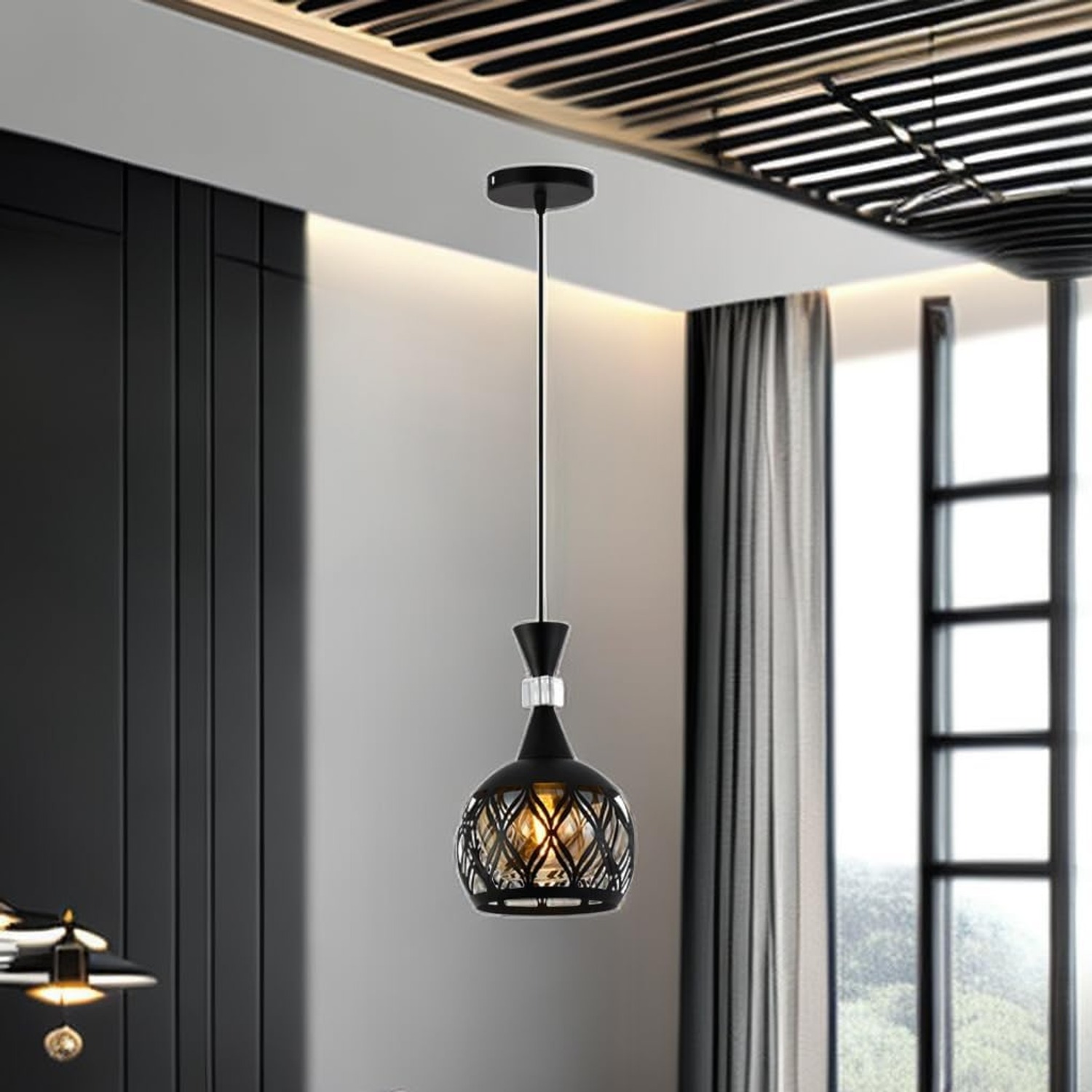
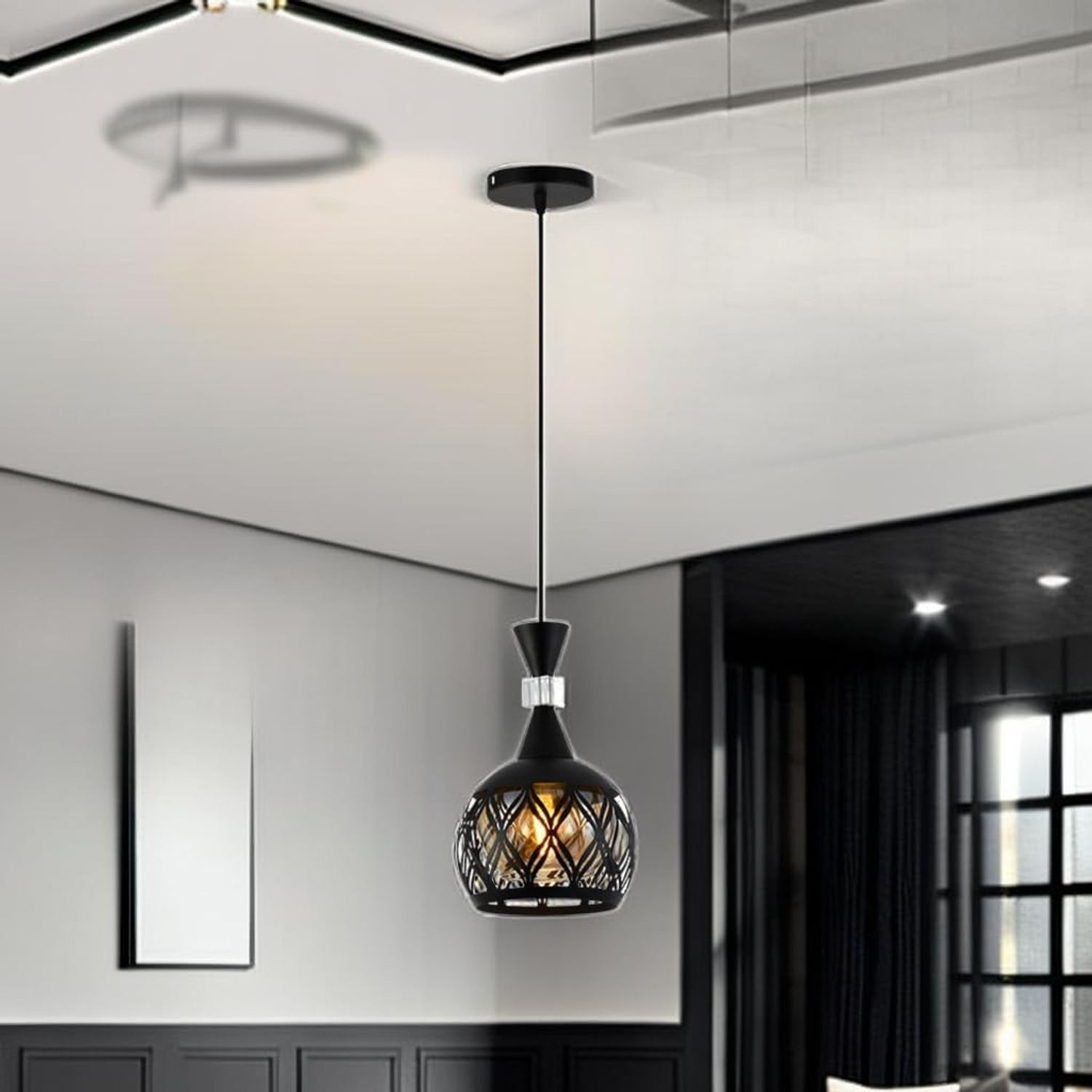
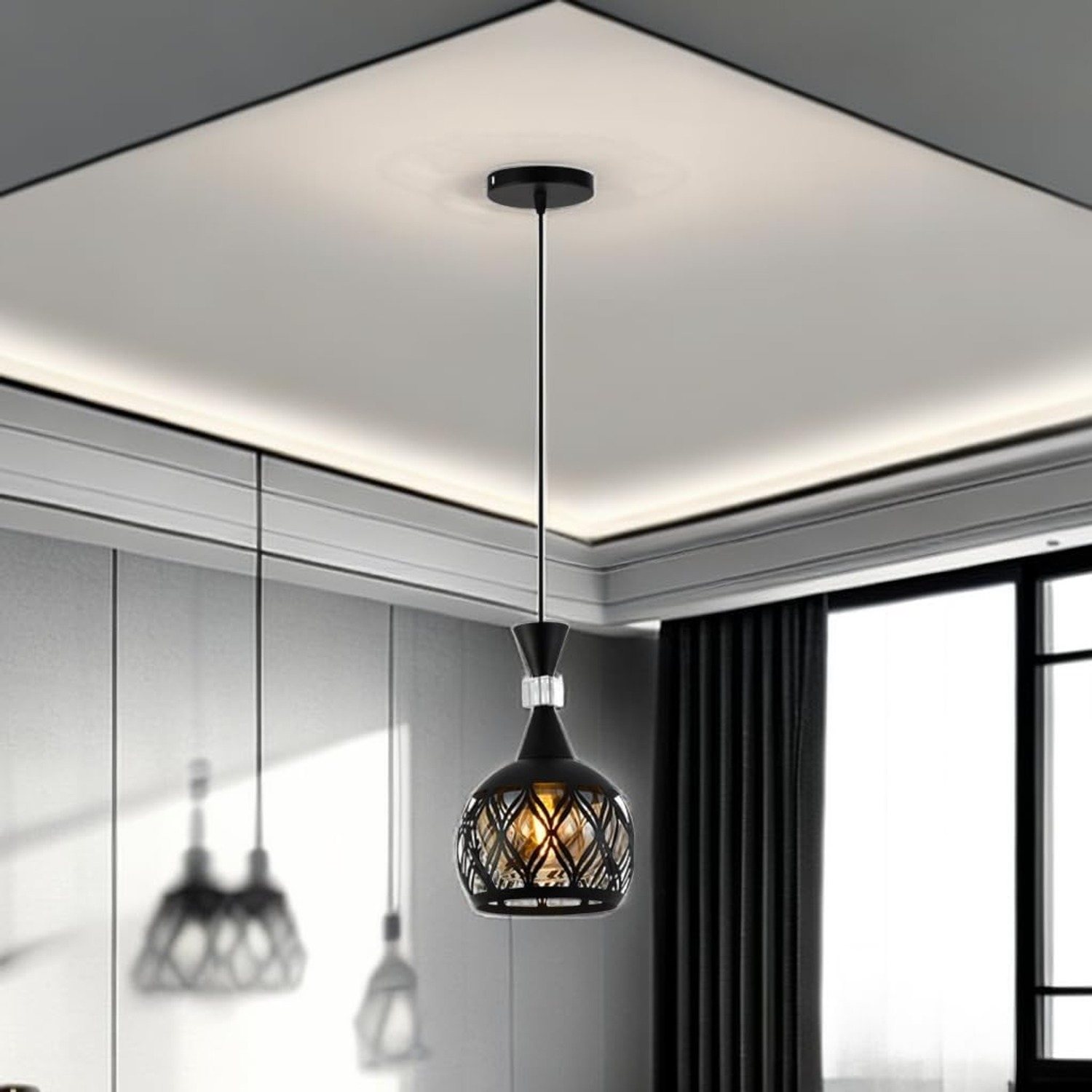
A black iron chandelier does that job and adds a second thing: a shape on the ceiling. Black metal against a pale ceiling is a strong, simple silhouette. You notice it during the day when the light is off, which is more than you can say for most fittings.
How this fitting works
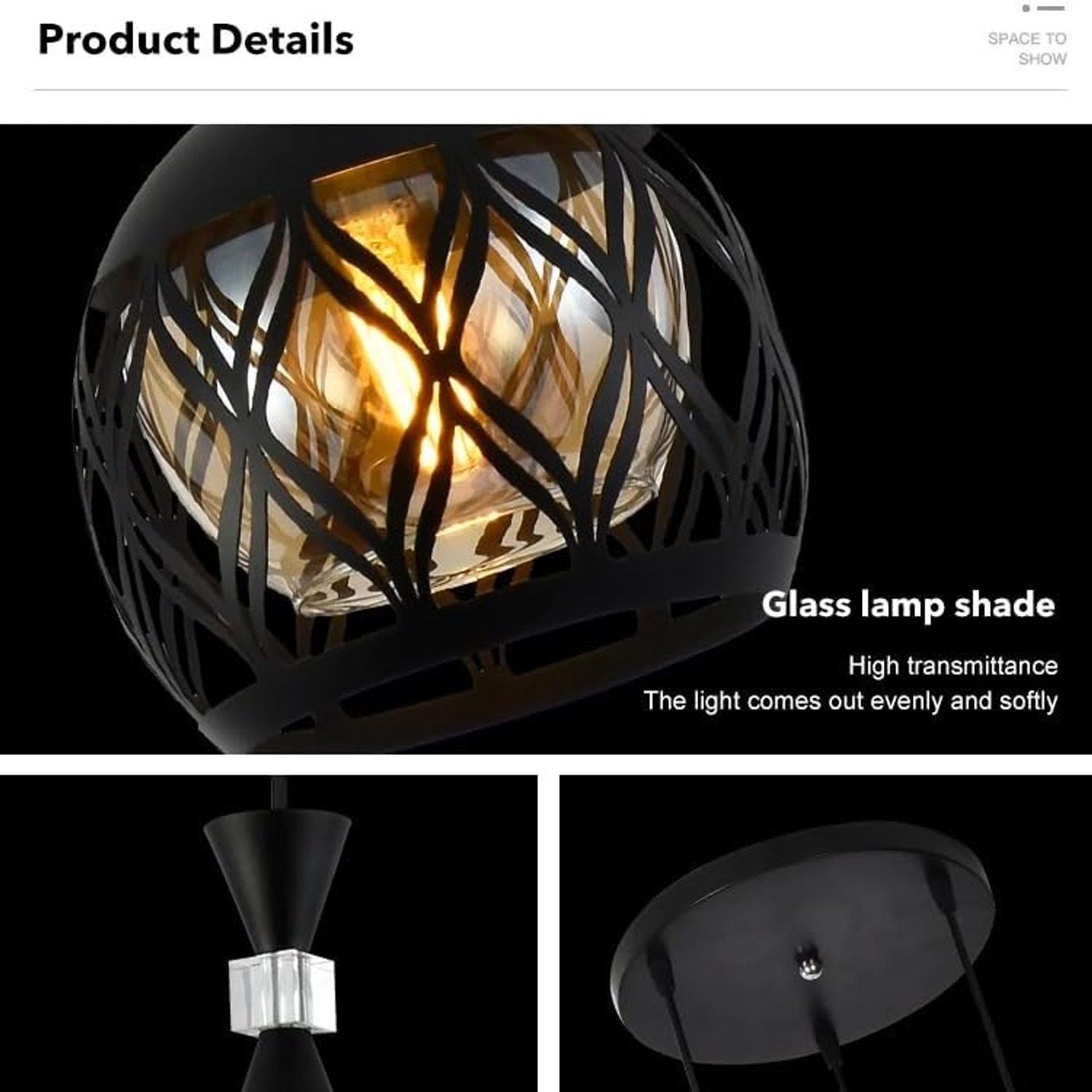
It is a single-light pendant. One bulb, one shade, a cord, and a ceiling mount. The shade here is round and made of iron with a matte black finish, cut through with an openwork pattern. That hollow-cut detail matters more than it sounds. A solid shade sends almost all the light straight down in a tight circle. An openwork shade sends the main beam down but lets some light through the sides, so the ceiling and walls pick up a pattern.
The bulb fitting is E27, which is the common large screw base used across most of the world. Maximum rating is 60 watts and the maker's description specifies 220 volts. An E27 base is good news for the long term, because you can put almost anything in it. A warm filament-look globe if you want the amber, vintage glow. A dimmable LED if you would rather pay less to run it. A smart bulb if you want to control it from your phone. The fitting itself does not lock you in.
The switch type is listed as pull chain and dimmer. Installation is a semi flush ceiling mount with a corded electric supply. It is for indoor use only and is not water resistant, so keep it away from bathrooms, laundries and anywhere exposed to weather.
Who it suits
This style earns its place in a few specific situations.
If you have a small to medium dining table and you are tired of overhead glare, a single pendant centred above it will change how the room feels at night. If you have a kitchen island or a long bench, a row of two or three matching pendants gives you proper task light without the bulk of a big fixture. Hallways and entryways are another good fit, because a dark pendant breaks up a long blank ceiling and gives the space a focal point.
It also works in bedrooms, either centred as the main light or hung on one side as a bedside pendant. If you go that route, a dimmable bulb is worth the small extra cost.
Where it is less suited: very large open-plan rooms where a single small pendant will look lost, and any damp area. For a big room, either buy several or choose a wider multi-light fixture.
Choosing the right drop height
This is where most people get it wrong, and it is the easiest thing to fix at install time because the cord is adjustable.
Over a dining table, the usual guidance is to leave roughly 75 to 90 centimetres between the tabletop and the bottom of the shade. That is low enough to feel intimate and high enough that people across the table can see each other. If your ceiling is higher than standard, you can go a little lower rather than hanging the light up near the ceiling where it does nothing.
Over a kitchen island, think about sightlines rather than the bench. The bottom of the shade should sit above the eye level of anyone standing at the bench, usually around 75 to 85 centimetres above the counter. If you are running several in a row, space them evenly and keep at least 60 centimetres between shades so they do not visually merge.
In a hallway or walkway, the rule is simpler. Nothing within reach of a tall person's head. Keep at least two metres of clearance from the floor.
Choosing the bulb
The fitting is amber and retro by design, so the bulb you pick does a lot of the styling work.
A filament-style globe with visible coils looks right in an openwork cage and casts the warmest light. The trade-off is running cost and heat. An LED filament bulb gets you very close to the same look at a fraction of the power, and most are available in warm colour temperatures around 2700K. Avoid cool white or daylight bulbs here. They clash badly with black metal and make the whole thing look like a work light.
If you plan to dim, check two things. First, that the bulb is marked dimmable. Second, that the dimmer circuit in your home is compatible with LED loads, since older dimmers were built for incandescent bulbs and can hum or flicker with LEDs. Your electrician will know in about ten seconds.
Installation, honestly
Assembly is required, and the package includes the shade and instructions. The assembly part is quick. The ceiling part is not something to improvise.
In most countries, hardwired ceiling lighting legally has to be installed by a licensed electrician. Even where that is not strictly the case, the circuit needs isolating, the mounting point needs to be sound, and the cord grip needs tightening properly so the fitting does not creep down over time. None of that is difficult for a professional, and it is a short job.
One practical tip: decide your drop height before the electrician arrives. Measure from your tabletop or bench, mark the height with masking tape on a wall, and stand back and look at it. Adjusting the cord during install takes a minute. Adjusting it a week later means getting someone back.
Looking after it
Black matte iron is low maintenance, but it is not no maintenance.
Turn the power off at the wall and let the bulb cool before you touch anything. Dust the shade with a dry soft cloth, or a barely damp one if there is grease build-up, which happens with kitchen pendants. Dry it straight away. Do not reach for solvents, bleach or scouring pads, because matte finishes scuff and go patchy where polished ones might survive.
Once a year, give the cord grip and the ceiling fixing a quick look. Anything that has loosened should be tightened, and if you are not comfortable doing that, mention it next time an electrician is in the house.
Kitchen pendants need cleaning more often than dining or bedroom ones, simply because cooking vapour settles on everything above a cooktop. A wipe every month or two keeps the finish even.
Matching it to what you already own
Black is the easiest metal finish to work with because it behaves like a neutral. It sits comfortably against timber, white walls, exposed brick, concrete and stainless steel. It does not need to match your door handles or your tapware the way brass or chrome does.
If the rest of your room is already quite busy, patterned tiles, bold wallpaper, a lot of artwork, then one black pendant adds structure without adding noise. If the room is plain, the openwork shade and the pattern it throws on the ceiling do the decorating for you.
Where it can go wrong is mixing too many metal finishes in a small space. If you have brass pendants over the island and you add a black one over the table two metres away, it can look unplanned. Either commit to one finish in a sightline or make the contrast obvious and deliberate.
The short version
This is a single-light black iron pendant with a round, hollow-cut matte shade, built for indoor rooms. It takes a common E27 bulb up to 60 watts at 220 volts, lists pull chain and dimmer switching, and mounts semi flush to the ceiling. Assembly is required and a bulb is not listed as included.
Buy it if you want to bring light down closer to a table, bench or entryway and give the ceiling a shape worth looking at. Hang it 75 to 90 centimetres above a tabletop, pair it with a warm bulb, keep it in dry rooms, and have an electrician do the ceiling connection. Dust it a few times a year and it will look the same in five years as it does on day one.