
The complete guide
How to Choose a French Country Chandelier for Your Home
The problem with a bare ceiling
Most rooms are decorated from the floor up. Rug, sofa, table, art on the wall, then everyone stops. The ceiling keeps whatever fitting the builder put there, usually a flat disc or a single bulb behind frosted glass. It lights the room, technically. It just does nothing for it.
Lighting is the one thing in a room that changes how everything else looks. Flat overhead light makes timber look dull and skin look tired. A chandelier with several smaller bulbs spreads light from a few points instead of one, which softens shadows and makes a dining table feel like somewhere you want to sit for a while. That is really what a French country chandelier is for. It is less about grandeur and more about warmth.
How this chandelier works
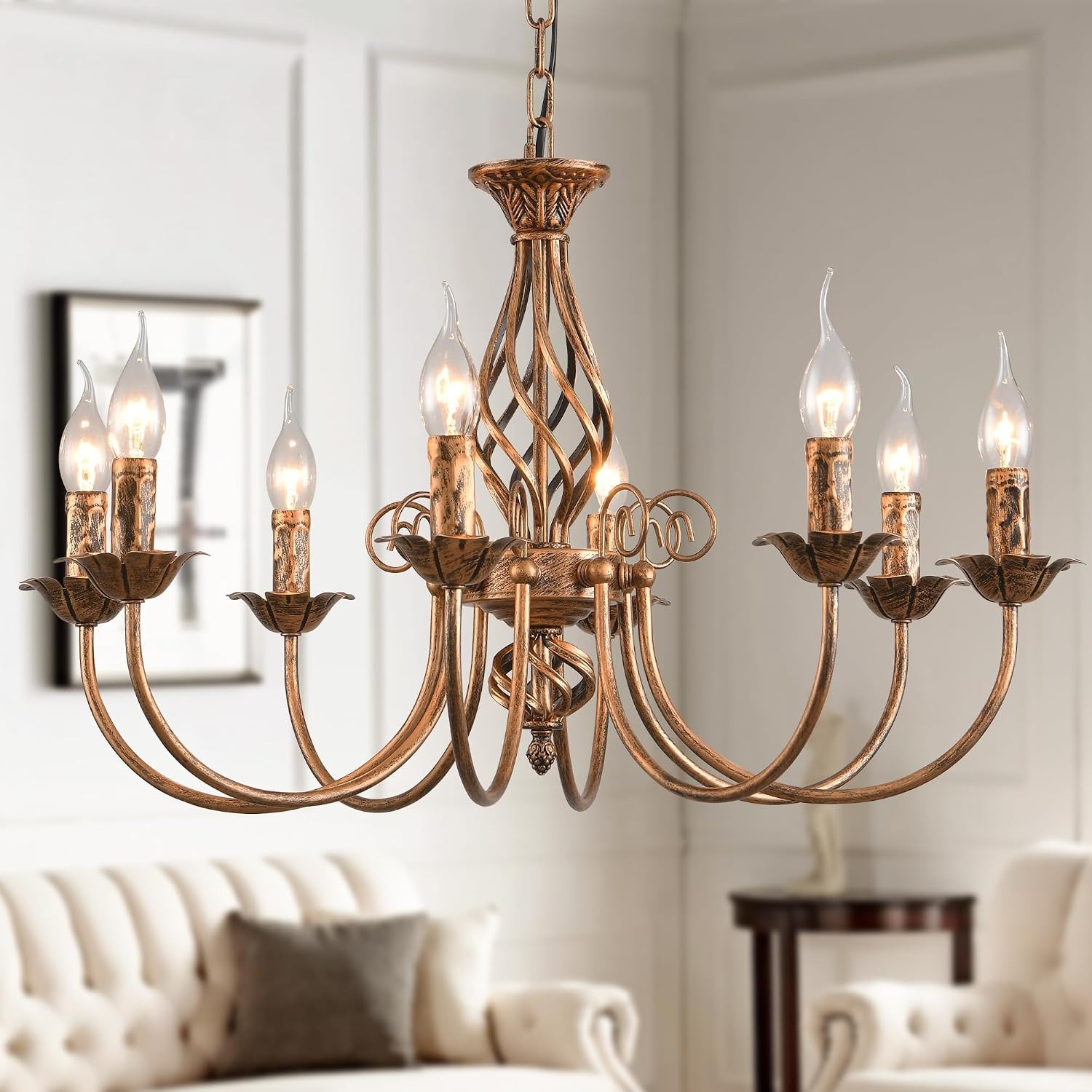
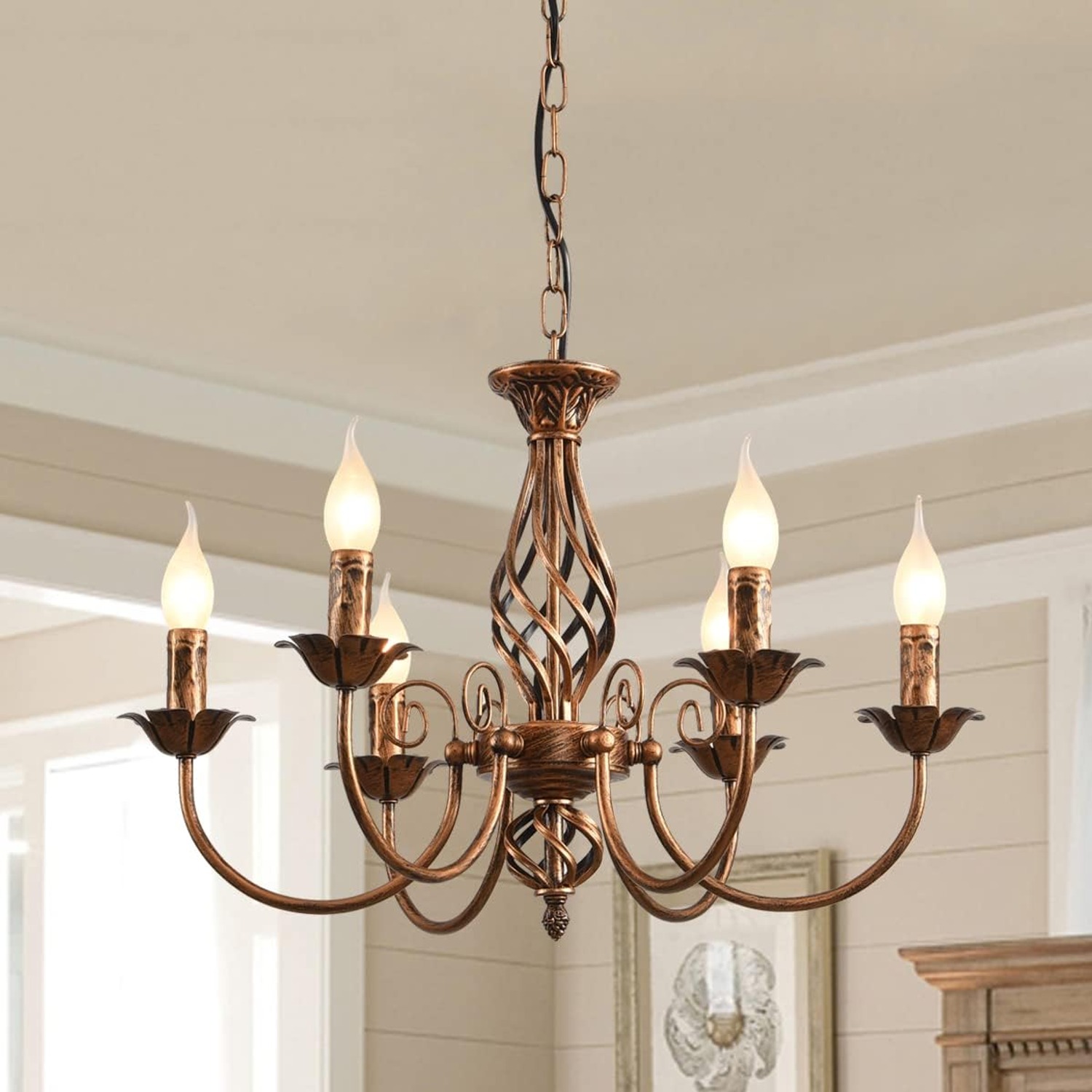
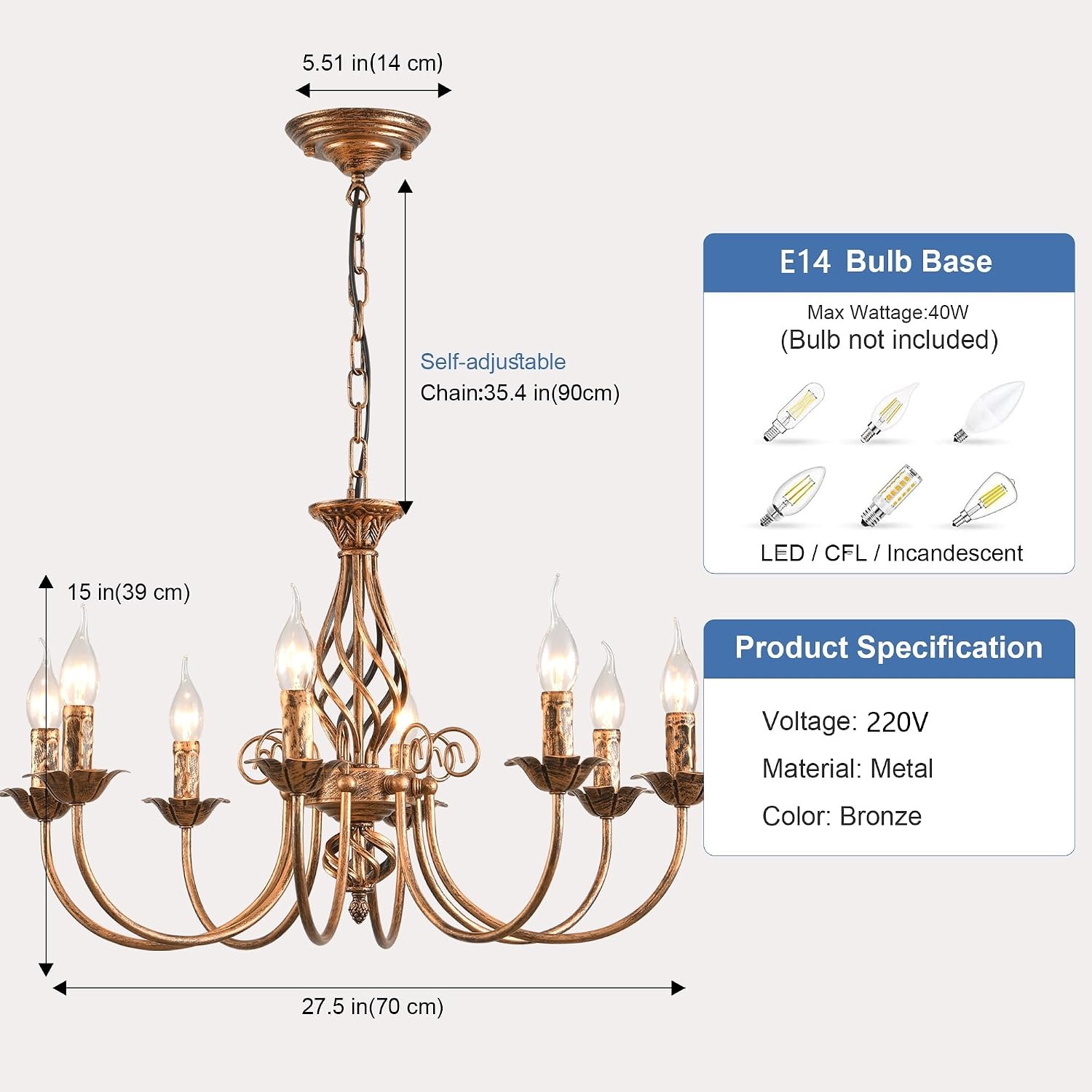
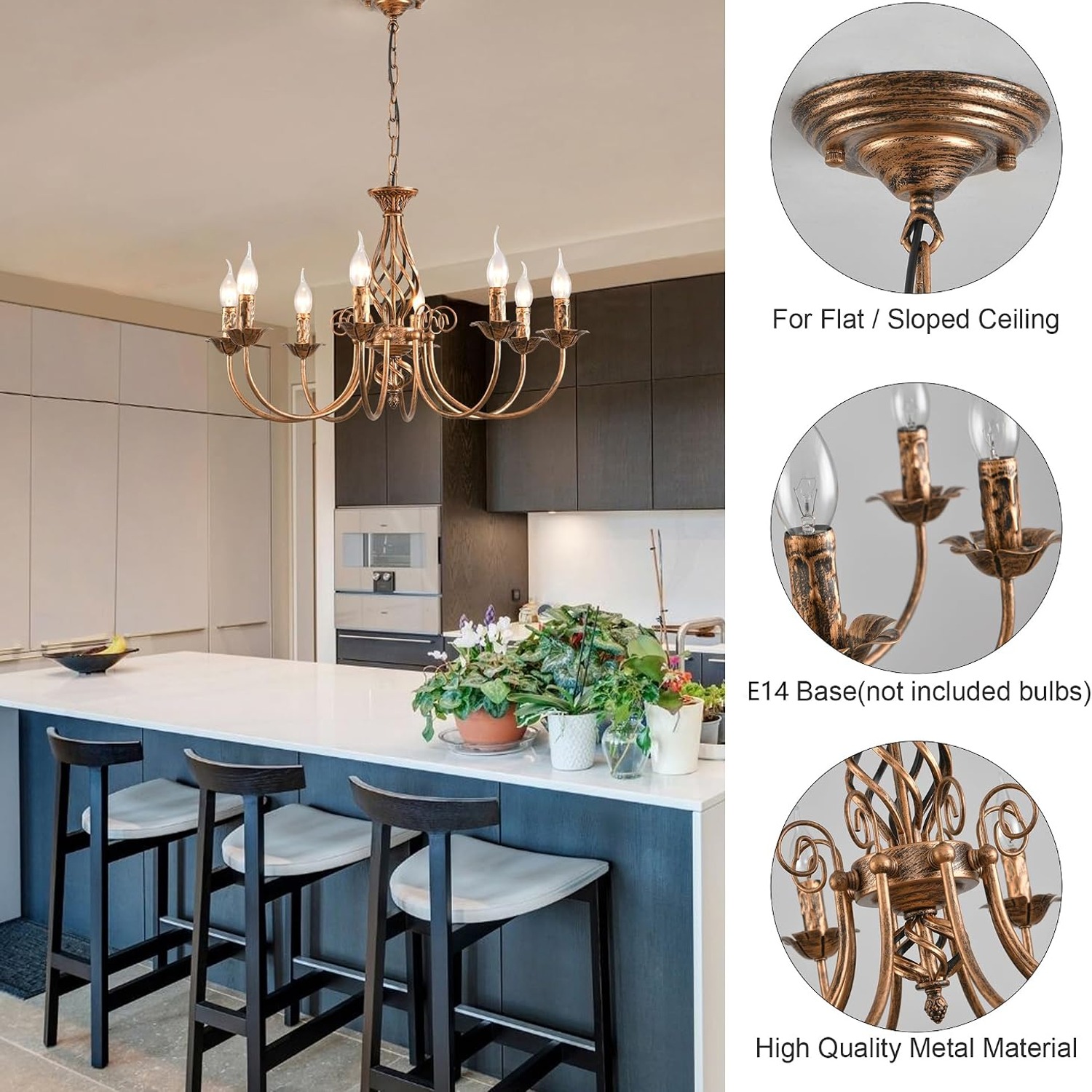
The frame is metal, with eight curved arms holding candle-style sockets and metal shades, all finished in brushed bronze. It hangs from a 90 cm chain with a canopy at the ceiling and a cover that hides the cable.
The chain is the clever part. The end link has a screw cap that opens, so you can take the canopy off and reattach it at any point on the chain. That means you set the exact drop you want rather than living with whatever length came in the box. It also means the fixture hangs level under a sloped or vaulted ceiling, because a chain naturally finds plumb. A rigid rod does not do that without an extra adapter.
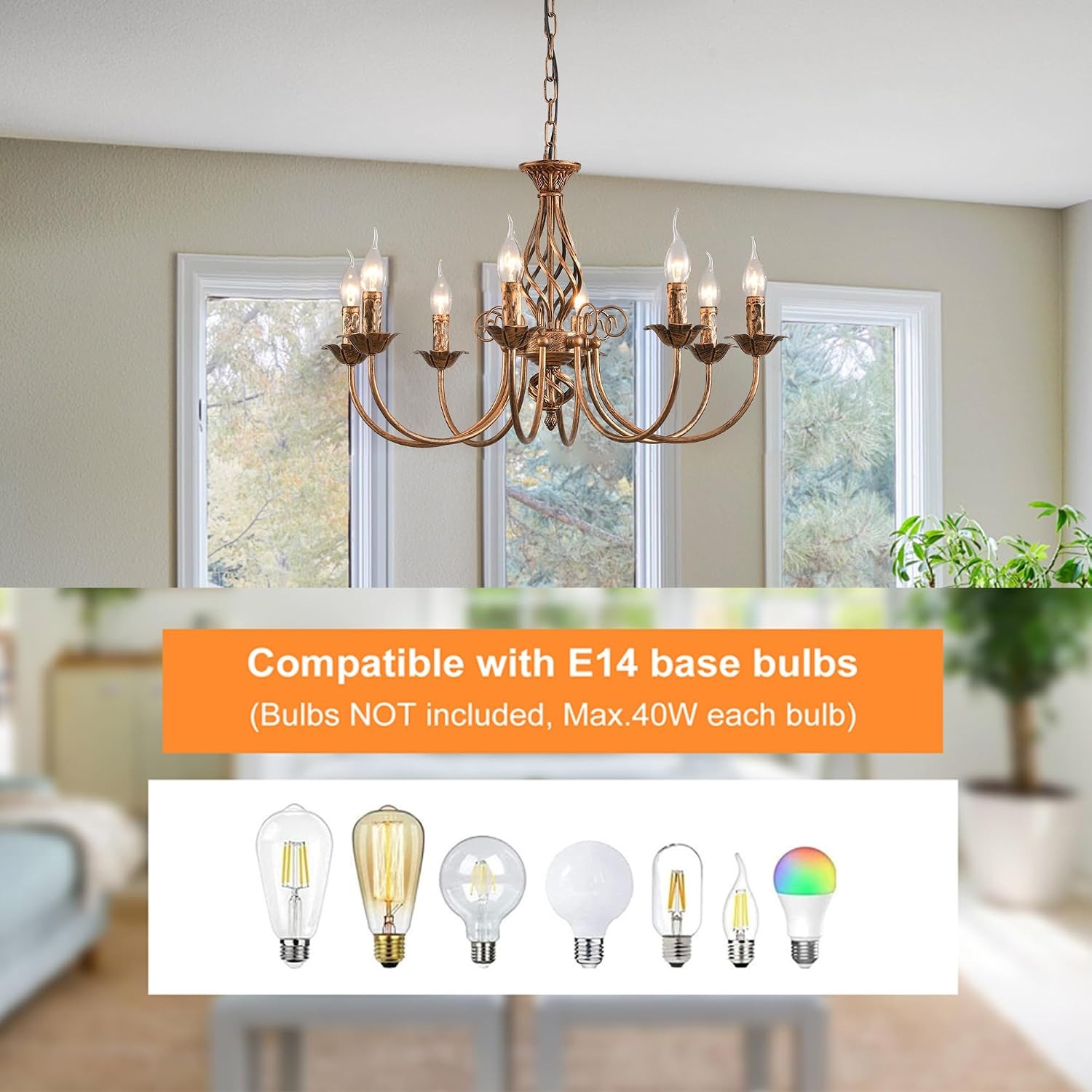
Power is standard mains at 220 V, wired to your ceiling point. Each of the eight sockets takes an E14 bulb up to 40 watts. Bulbs are not given by the maker, and that is deliberate. You choose the look. Maximum output across the fixture is listed at 8000 lumens, which is plenty for a dining room or an open kitchen if you run higher-output bulbs.
Dimming is supported, with a condition. The fixture itself has no dimmer built in, so you need dimmable bulbs and a dimmer switch that is rated to work with them. Fit that combination and the room goes from bright at dinner to low and quiet afterwards with one dial.
Who it suits
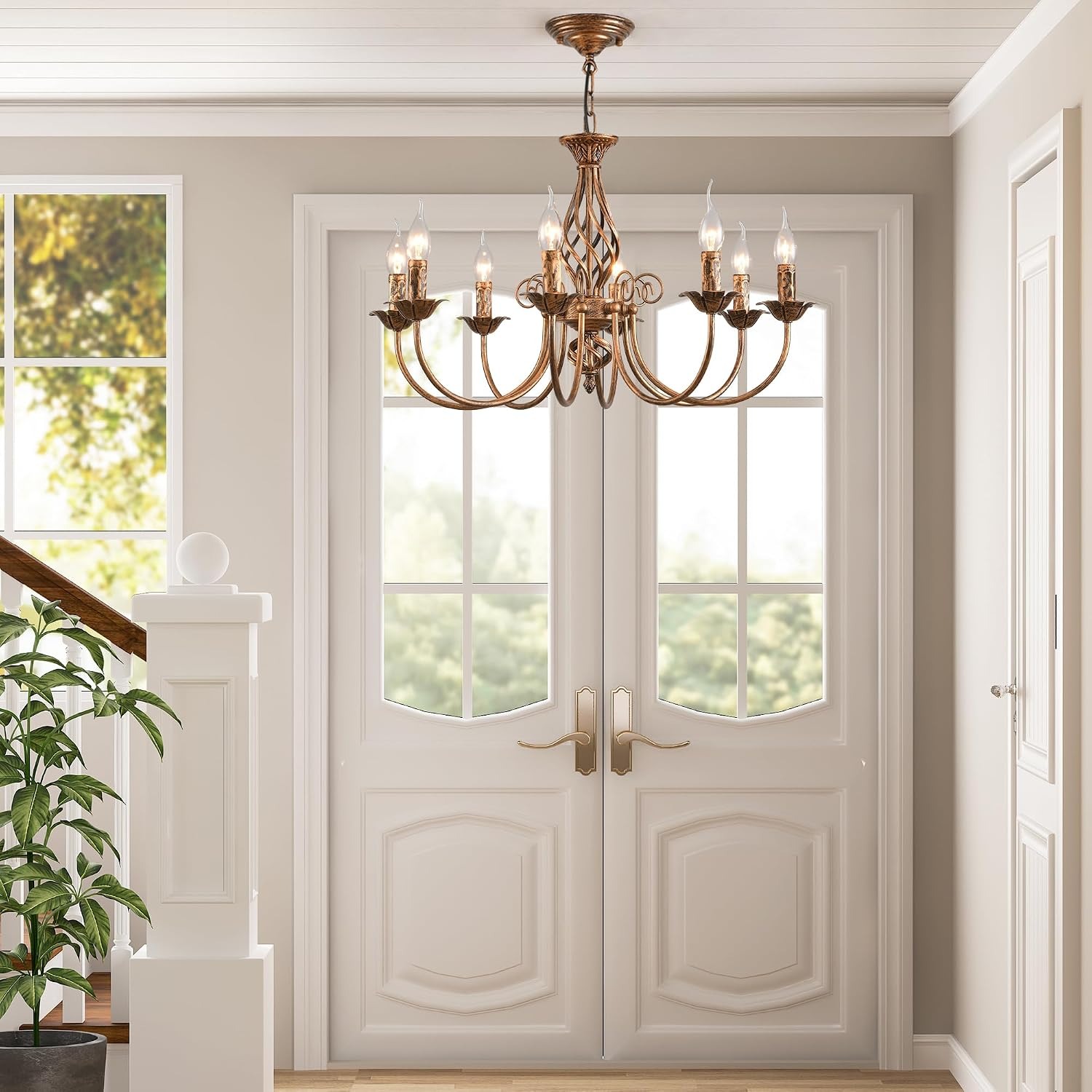
This design sits in that useful middle ground where it does not demand a period house. A vintage metal chandelier in bronze works in a farmhouse kitchen, a modern apartment with white walls, a renovated cottage, or a rental where you are allowed to swap a light fitting.
It suits you if:
- You have a dining table, island or entry hall that is lit by one dull fixture.
- Your ceiling is at standard height or above, with enough room for a hanging light.
- You want warmth and texture rather than a sleek, minimal look.
- You like the idea of controlling the mood with a dimmer.
It is less of a fit if your ceilings are low enough that people would walk into it, or if the room is damp. The fixture is indoor only and not water resistant, so bathrooms, laundries and covered outdoor areas are out.
Getting the height right
This is where most people go wrong, and it is easy to get right.
Over a dining table, aim for roughly 75 to 90 cm between the tabletop and the lowest point of the fixture. That keeps the light where it is useful and keeps it out of your sightline across the table. If your ceiling is higher than the usual 2.4 metres, you can let it hang a little lower.
In a hallway or entry, the rule changes. Here you want clearance for people, so keep at least 2.1 metres from the floor to the bottom of the fixture. If the entry is double height, a lower drop looks better than a fitting stranded near the ceiling.
Over a kitchen island, treat it like a dining table but check the sightline from the sink or cooktop. You want to be able to see the person on the other side.
The listed item dimensions are 34 x 17 x 44.5 cm, so the fixture itself is not enormous. Add the chain length you choose to the fixture height to get the total drop, then measure that down from your ceiling with a tape before anyone drills anything.
Picking bulbs
Eight sockets gives you eight chances to change the character of the room. A few guidelines that work in practice.
For a soft, old-world look, choose warm white LED filament candle bulbs around 2700 K. The visible filament suits an open-arm chandelier where the bulb is part of the design. For a brighter, cleaner feel, step up to 3000 K or 4000 K. Avoid anything cooler than that unless the chandelier is in a workspace, because cold light fights the bronze finish.
Stay within the 40 watt maximum per socket. With LED, you will be nowhere near that figure, since a typical candle LED draws 4 to 6 watts and still outputs the equivalent of a 40 watt incandescent. If you plan to dim, buy dimmable bulbs and check they match your dimmer. Mixing dimmable and non-dimmable bulbs in the same fixture is the usual cause of flicker.
Buy all eight bulbs at once, from the same batch if you can. Mismatched colour temperatures across a chandelier are very obvious once the lights go on.
Installation and safety
The fixture requires assembly. You build the centre column and arms, set the chain to your chosen length, then connect the wiring and fit the bulbs. Mounting hardware and an instruction manual come in the box.
Professional installation is recommended, and in many places mains wiring must be done by a licensed electrician anyway. A sensible split is to assemble the body yourself on a table, then book the electrician for the connection and hanging. It saves you money and saves them time.
One thing to check before the booking: the ceiling point. At 11.5 kg, this is a real weight hanging from one spot. The mounting bracket needs to be fixed to a joist or an approved ceiling box rated for the load, not just screwed into plasterboard. Your electrician will assess this, but it is worth flagging when you book so they bring the right fixings.
Always isolate the circuit at the breaker before any work, and never test the fitting while it is loose.
Keeping it looking good
Maintenance is light. Metal frames and metal shades mean no glass to wash and no fabric to yellow.
Switch the power off and let the bulbs cool before you touch anything. Dust the arms and frame with a dry microfibre cloth or a soft duster, working from the top down. A long-handled duster handles most of it from the floor. For the occasional mark, use a cloth that is only slightly damp and dry it straight away.
Skip abrasive pads, bleach and solvent cleaners. They will strip the brushed finish. Keep water well away from the sockets and wiring. Twice a year is plenty for a room that is not near a kitchen, and maybe four times a year if it hangs over a cooking area where grease drifts.
Give the chain and canopy a quick look while you are up there. Fittings can work slightly loose over years of expansion and contraction, and a thirty-second check is cheap insurance.
The short version
If your dining room or entry is lit by something you have never once looked at, this is the kind of fixture that changes the room. Eight E14 bulbs on a brushed bronze metal frame, hung on a 90 cm chain you can shorten to any length, suitable for flat and sloped ceilings alike. Choose warm dimmable bulbs, hang it 75 to 90 cm above the table, get a licensed electrician to connect it, and dust it a couple of times a year.
It is indoor only, it weighs 11.5 kg so the ceiling fixing matters, and bulbs are a separate purchase. Everything else is included, along with a two year manufacturer warranty.